2026 income limits for Medicaid, CHIP, SNAP, WIC and LIHEAP, by state
Checked November 13, 2026 · Updated when the poverty guidelines change in January and SNAP and LIHEAP limits change in October · Published by Grantsights
In Alabama, a parent in a family of 3 loses Medicaid above $410 a month while the children stay covered up to $7,218. In 8 states, adults without children or a disability can't get Medicaid at any income.
The table gives each program's monthly gross income limit for households of 1 to 4 in all 50 states and DC, with the rule behind it and a link to the official source. The free CSV has households of 1 to 8, the effective date and the date we checked each figure. To see which of these a household may qualify for, try the free eligibility checker.
Monthly income limits by state and program
The ACA expansion group: adults 19 to 64 without dependent children or a disability.
- * District of Columbia: DC cut adult Medicaid from 215% to 138% on January 1, 2026; adults from 138% to 200% moved to the Healthy DC Plan, which isn't Medicaid.
- * Georgia: Georgia Pathways, a waiver with a work and activity requirement (80 hours a month), not the ACA expansion. Its rules change January 1, 2027.
- * Nevada: Nevada's newest posted chart still uses 2025 dollars; the same percent is applied to the 2026 guidelines here.
- * Oklahoma: KFF's 138%. Oklahoma's own chart prints a little more, $1,848 for one person (about 139%).
- * Wisconsin: BadgerCare Plus covers adults without children to 100% of poverty under a waiver; Wisconsin hasn't adopted the ACA expansion.
The highest limit at which a parent or caretaker relative gets full Medicaid, through the parent group or the expansion group.
- * Alabama: Sizes 1 to 4 as printed on Alabama Medicaid's 2026 income chart (18% of poverty with the disregard); sizes 5 to 8 apply the same 18%.
- * Connecticut: HUSKY A parents now stop at 138%, down from 155%.
- * District of Columbia: Cut from 221% to 138% on January 1, 2026.
- * Florida: Florida's fixed dollar standard as printed on DCF's chart for April 2026 to March 2027, with its disregards built in.
- * Georgia: Through Georgia Pathways, with its work requirement. Regular parent Medicaid stops at $662 a month for a family of 3 (DFCS Appendix A2, March 2026).
- * Kansas: Kansas sets Caretaker Medical at 38% of poverty; its F-8 dollar chart couldn't be opened, so the dollars are calculated.
- * Mississippi: Mississippi's fixed dollar standard from the Division of Medicaid chart effective March 1, 2026. The agency site was down on November 13, 2026, so the chart couldn't be re-read there.
- * South Carolina: South Carolina prints 62% of poverty; 67% here includes the 5% disregard.
- * Tennessee: TennCare's Caretaker Relative limit is 100% of poverty; 105% here includes the 5% disregard.
- * Texas: Texas's fixed dollar standard for a one-parent household (Texas Works Handbook C-131.2), plus the 5% disregard. The standard hasn't changed since 2015.
- * Wyoming: Wyoming's Family Care fixed dollar standard (Medicaid Table 1, April 1, 2026), plus the 5% disregard.
The highest limit at which a child aged 6 to 18 gets Medicaid or CHIP. Some states charge CHIP premiums near the top.
- * Florida: KFF's figure. Florida KidCare's own chart shows subsidized coverage to 200% of poverty, before the MAGI conversion and disregard.
- * New Mexico: Ages 6 to 18; New Mexico covers children under 6 to 305%.
- * Oklahoma: KFF's 210%. Oklahoma's own chart prints a little more, $2,806 for one person (about 211%).
The highest limit for a pregnant woman in Medicaid or CHIP. Most states count the unborn child in the household size.
- * Alabama: Through ALL Babies (CHIP), which covers prenatal care. Full Medicaid for pregnant women stops at 146% of poverty ($3,324 a month for a family of 3).
- * Oklahoma: KFF's 210%. Oklahoma's own chart prints a little more, $2,806 for one person (about 211%).
The gross monthly income limit for a household without an elderly or disabled member, after the state's broad-based categorical eligibility (BBCE). Households also have to pass the net income test unless BBCE makes them eligible.
- * Arkansas: 130% for most households; 165% for households with an elderly or disabled member under Arkansas's BBCE.
- * Idaho: No broad-based categorical eligibility, so the federal 130% gross test applies.
- * Indiana: No broad-based categorical eligibility, so the federal 130% gross test applies.
- * Kansas: No broad-based categorical eligibility, so the federal 130% gross test applies.
- * Maine: Maine's own chart for October 2026 still prints 2025-based dollars ($5,359 for 4); 200% of the 2026 guidelines is shown.
- * Mississippi: No broad-based categorical eligibility, so the federal 130% gross test applies.
- * Missouri: No broad-based categorical eligibility, so the federal 130% gross test applies.
- * New York: New York's BBCE limit is 150% for households with earnings and 200% for those with dependent care costs; 130% otherwise.
- * Ohio: Ohio's rule (Ohio Administrative Code 5101:4-2-02, effective November 1, 2026) sets 200% for households sent the Ohio careline notice at application or renewal. USDA's November 2026 chart still lists Ohio at 130%.
- * Oregon: Oregon's chart runs March 2026 to February 2027, with these same dollars.
- * South Dakota: No broad-based categorical eligibility, so the federal 130% gross test applies.
- * Tennessee: Tennessee's FY2027 chart also prints a 200% column and the Tennessee Justice Center reports the state adopted BBCE in 2026, but USDA's November 2026 chart doesn't list Tennessee, so the federal 130% is shown.
- * Utah: No broad-based categorical eligibility, so the federal 130% gross test applies.
- * Wyoming: No broad-based categorical eligibility, so the federal 130% gross test applies.
185% of poverty, the federal maximum, used in every state. People on Medicaid, SNAP or TANF qualify on income automatically.
| Rule | Our guides | |||||
|---|---|---|---|---|---|---|
| Alabama | $2,461 | $3,337 | $4,212 | $5,088 | 185% of poverty | Medicaid · SNAP · LIHEAP |
| Alaska | $3,076 | $4,171 | $5,265 | $6,360 | 185% of poverty | Medicaid · LIHEAP |
| Arizona | $2,461 | $3,337 | $4,212 | $5,088 | 185% of poverty | Medicaid · SNAP · LIHEAP |
| Arkansas | $2,461 | $3,337 | $4,212 | $5,088 | 185% of poverty | Medicaid · SNAP · LIHEAP |
| California | $2,461 | $3,337 | $4,212 | $5,088 | 185% of poverty | Medicaid · WIC · LIHEAP |
| Colorado | $2,461 | $3,337 | $4,212 | $5,088 | 185% of poverty | Medicaid · SNAP · LIHEAP |
| Connecticut | $2,461 | $3,337 | $4,212 | $5,088 | 185% of poverty | Medicaid · SNAP · LIHEAP |
| Delaware | $2,461 | $3,337 | $4,212 | $5,088 | 185% of poverty | Medicaid · SNAP · LIHEAP |
| District of Columbia | $2,461 | $3,337 | $4,212 | $5,088 | 185% of poverty | Medicaid · SNAP · LIHEAP |
| Florida | $2,461 | $3,337 | $4,212 | $5,088 | 185% of poverty | Medicaid · SNAP · WIC · LIHEAP |
| Georgia | $2,461 | $3,337 | $4,212 | $5,088 | 185% of poverty | Medicaid · SNAP · LIHEAP |
| Hawaii | $2,831 | $3,838 | $4,844 | $5,851 | 185% of poverty | Medicaid · SNAP · LIHEAP |
| Idaho | $2,461 | $3,337 | $4,212 | $5,088 | 185% of poverty | Medicaid · SNAP · LIHEAP |
| Illinois | $2,461 | $3,337 | $4,212 | $5,088 | 185% of poverty | Medicaid · SNAP · LIHEAP |
| Indiana | $2,461 | $3,337 | $4,212 | $5,088 | 185% of poverty | Medicaid · SNAP · WIC · LIHEAP |
| Iowa | $2,461 | $3,337 | $4,212 | $5,088 | 185% of poverty | Medicaid · SNAP · LIHEAP |
| Kansas | $2,461 | $3,337 | $4,212 | $5,088 | 185% of poverty | Medicaid · SNAP · LIHEAP |
| Kentucky | $2,461 | $3,337 | $4,212 | $5,088 | 185% of poverty | Medicaid · SNAP · LIHEAP |
| Louisiana | $2,461 | $3,337 | $4,212 | $5,088 | 185% of poverty | Medicaid · SNAP · LIHEAP |
| Maine | $2,461 | $3,337 | $4,212 | $5,088 | 185% of poverty | Medicaid · SNAP · LIHEAP |
| Maryland | $2,461 | $3,337 | $4,212 | $5,088 | 185% of poverty | Medicaid · SNAP · LIHEAP |
| Massachusetts | $2,461 | $3,337 | $4,212 | $5,088 | 185% of poverty | Medicaid · SNAP · LIHEAP |
| Michigan | $2,461 | $3,337 | $4,212 | $5,088 | 185% of poverty | Medicaid · SNAP |
| Minnesota | $2,461 | $3,337 | $4,212 | $5,088 | 185% of poverty | Medicaid · SNAP · LIHEAP |
| Mississippi | $2,461 | $3,337 | $4,212 | $5,088 | 185% of poverty | Medicaid · SNAP · LIHEAP |
| Missouri | $2,461 | $3,337 | $4,212 | $5,088 | 185% of poverty | Medicaid · SNAP · WIC · LIHEAP |
| Montana | $2,461 | $3,337 | $4,212 | $5,088 | 185% of poverty | Medicaid · LIHEAP |
| Nebraska | $2,461 | $3,337 | $4,212 | $5,088 | 185% of poverty | Medicaid · SNAP · LIHEAP |
| Nevada | $2,461 | $3,337 | $4,212 | $5,088 | 185% of poverty | Medicaid · SNAP · LIHEAP |
| New Hampshire | $2,461 | $3,337 | $4,212 | $5,088 | 185% of poverty | Medicaid · SNAP · LIHEAP |
| New Jersey | $2,461 | $3,337 | $4,212 | $5,088 | 185% of poverty | Medicaid · SNAP · LIHEAP |
| New Mexico | $2,461 | $3,337 | $4,212 | $5,088 | 185% of poverty | Medicaid · SNAP · LIHEAP |
| New York | $2,461 | $3,337 | $4,212 | $5,088 | 185% of poverty | Medicaid · SNAP |
| North Carolina | $2,461 | $3,337 | $4,212 | $5,088 | 185% of poverty | Medicaid · SNAP · LIHEAP |
| North Dakota | $2,461 | $3,337 | $4,212 | $5,088 | 185% of poverty | Medicaid · LIHEAP |
| Ohio | $2,461 | $3,337 | $4,212 | $5,088 | 185% of poverty | Medicaid · SNAP · WIC |
| Oklahoma | $2,461 | $3,337 | $4,212 | $5,088 | 185% of poverty | Medicaid · SNAP · WIC · LIHEAP |
| Oregon | $2,461 | $3,337 | $4,212 | $5,088 | 185% of poverty | Medicaid · SNAP · LIHEAP |
| Pennsylvania | $2,461 | $3,337 | $4,212 | $5,088 | 185% of poverty | Medicaid · SNAP · WIC · LIHEAP |
| Rhode Island | $2,461 | $3,337 | $4,212 | $5,088 | 185% of poverty | Medicaid · SNAP · LIHEAP |
| South Carolina | $2,461 | $3,337 | $4,212 | $5,088 | 185% of poverty | Medicaid · SNAP · LIHEAP |
| South Dakota | $2,461 | $3,337 | $4,212 | $5,088 | 185% of poverty | Medicaid · LIHEAP |
| Tennessee | $2,461 | $3,337 | $4,212 | $5,088 | 185% of poverty | Medicaid · SNAP · WIC · LIHEAP |
| Texas | $2,461 | $3,337 | $4,212 | $5,088 | 185% of poverty | Medicaid · SNAP · WIC |
| Utah | $2,461 | $3,337 | $4,212 | $5,088 | 185% of poverty | Medicaid · SNAP · WIC · LIHEAP |
| Vermont | $2,461 | $3,337 | $4,212 | $5,088 | 185% of poverty | Medicaid · LIHEAP |
| Virginia | $2,461 | $3,337 | $4,212 | $5,088 | 185% of poverty | Medicaid · SNAP · LIHEAP |
| Washington | $2,461 | $3,337 | $4,212 | $5,088 | 185% of poverty | Medicaid · SNAP · LIHEAP |
| West Virginia | $2,461 | $3,337 | $4,212 | $5,088 | 185% of poverty | Medicaid · SNAP · LIHEAP |
| Wisconsin | $2,461 | $3,337 | $4,212 | $5,088 | 185% of poverty | Medicaid · SNAP · LIHEAP |
| Wyoming | $2,461 | $3,337 | $4,212 | $5,088 | 185% of poverty | Medicaid · LIHEAP |
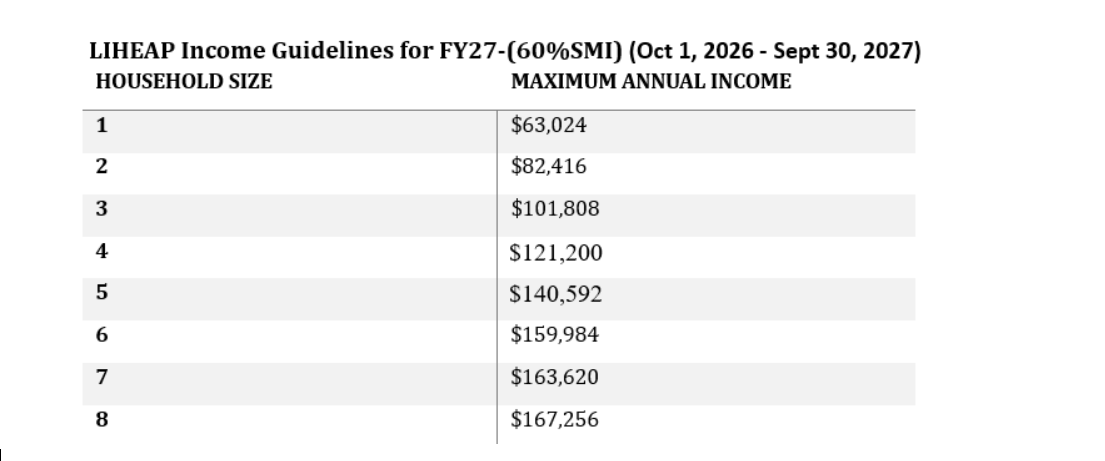
The state's income limit for regular heating help. Federal law caps it at the greater of 150% of poverty and 60% of state median income.

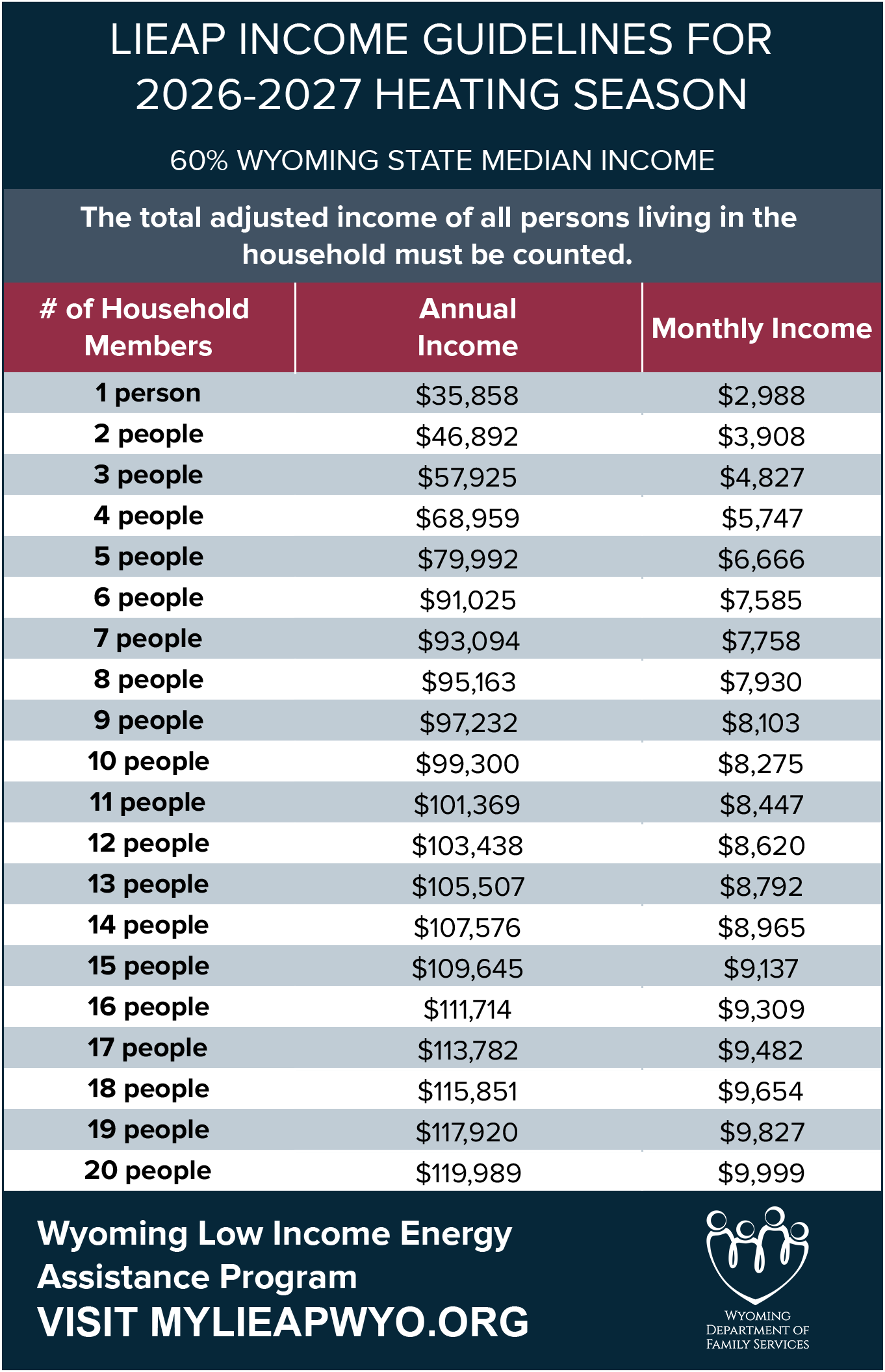
- * Alabama: ADECA's FY2027 plan sets 150% of the 2026 guidelines and works the one-person example ($1,995); larger sizes apply the same rule.
- * Alaska: Alaska's state-funded Heating Assistance Program goes higher, to 225% of the Alaska guideline.
- * Arkansas: The state's posted chart was still the FY2026 one on November 13, 2026. Its FY2027 plan sets 60% of state median income for 1 to 7 people and 150% of poverty for 8 or more, so these are ACF's FY2027 figures for that rule divided by 12 and rounded down.
- * California: The state's posted chart was still the FY2026 one on November 13, 2026. Its FY2027 plan sets 60% of state median income, so these are ACF's FY2027 figures for that rule divided by 12 and rounded down.
- * Florida: The state's posted chart was still the FY2026 one on November 13, 2026. Its FY2027 plan sets 60% of state median income, so these are ACF's FY2027 figures for that rule divided by 12 and rounded down.
- * Georgia: Georgia's FY2027 plan sets 60% of state median income, but DFCS prints no dollar chart; these are ACF's FY2027 60% figures divided by 12.
- * Idaho: The state's posted chart was still the FY2026 one on November 13, 2026. Its FY2027 plan sets 60% of state median income for 1 to 9 people, so these are ACF's FY2027 figures for that rule divided by 12 and rounded down.
- * Illinois: Illinois also gives state-funded help up to 300% of poverty to customers of the large regulated utilities (Ameren, ComEd, Nicor, Peoples Gas, North Shore Gas).
- * Kansas: As printed, the 3-person limit is $3,414; 150% of the 2026 guidelines would be $3,415.
- * Louisiana: The state's posted chart was still the FY2026 one on November 13, 2026. Its FY2027 plan sets 60% of state median income, so these are ACF's FY2027 figures for that rule divided by 12 and rounded down.
- * Maryland: Maryland's Office of Home Energy Programs uses 200% of poverty for its July 2026 to June 2027 year.
- * Michigan: Michigan pays LIHEAP heating help as the Home Heating Credit; these are Treasury's tax year 2025 annual ceilings divided by 12. The alternate calculation allows somewhat higher incomes.
- * Minnesota: Minnesota uses 50% of state median income, below the federal 60% ceiling.
- * Mississippi: Mississippi's FY2027 plan sets 60% of state median income, but MDHS prints no dollar chart; these are ACF's FY2027 60% figures divided by 12.
- * Ohio: Ohio prints 12-month and 30-day limits for its July 2026 to May 2027 HEAP year; these are the 12-month limits divided by 12.
- * South Carolina: The state's posted chart was still the FY2026 one on November 13, 2026. Its FY2027 plan sets 60% of state median income, so these are ACF's FY2027 figures for that rule divided by 12 and rounded down.
- * South Dakota: FY2026 chart (from October 2025); no FY2027 limits were posted by November 13, 2026. South Dakota prints 3-month limits for the 2025-26 heating season, divided by 3 here.
- * Texas: Texas's CEAP runs on the calendar year and already uses the 2026 guidelines.
- * Utah: Utah's FY2027 plan sets 150% of poverty; the DWS chart couldn't be opened on November 13, 2026, so these are 150% of the 2026 guidelines.
- * Vermont: Vermont's own choice: 185% of poverty for seasonal fuel help and 200% for crisis fuel.
- * Virginia: The state's posted chart was still the FY2026 one on November 13, 2026. Its FY2027 plan sets 150% of the 2026 poverty guidelines, so these are ACF's FY2027 figures for that rule divided by 12 and rounded down.
Gross monthly income, before taxes. Medicaid figures follow KFF's convention and include the 5% income disregard, so the ACA expansion limit shows as 138%. Dollar figures for percent-based rules are 2026 poverty guidelines times the percent, divided by 12 and rounded up, as most state charts do; a state's own chart can differ by a dollar. Each "Rule" links to the page we checked.
What the numbers show
- The widest gap between children and parents is in Alabama. For a family of 3, the children are covered up to $7,218 a month and a parent only up to $410, a gap of $6,808.
- In 6 states, a parent in a family of 3 loses Medicaid below $1,000 a month: Texas ($344), Alabama ($410), Mississippi ($498), Florida ($600), Kansas ($866) and Wyoming ($987). None of them has expanded Medicaid.
- 10 states haven't adopted the ACA expansion of Medicaid. In 8 of them (Alabama, Florida, Kansas, Mississippi, South Carolina, Tennessee, Texas and Wyoming), an adult without children or a disability can't get Medicaid on income alone. Georgia and Wisconsin cover those adults up to 100% of poverty through waivers instead, Georgia only with a work requirement.
- The same family can pass SNAP's income test in one state and fail it next door. 29 of the 50 states and DC let a household earn up to 200% of poverty through broad-based categorical eligibility, and 14 keep the federal 130%. For a family of 4 outside Alaska and Hawaii, that's the difference between $3,575 and $5,500 a month.
- LIHEAP heating limits vary the most. For a family of 4 outside Alaska and Hawaii they run from $2,948 a month in Michigan (where the help comes as a tax credit) to $10,100 in DC, because states choose between a share of poverty and a share of state median income.
How we built it: sources and dates
- Poverty guidelines. The 2026 HHS poverty guidelines (91 FR 1797, published January 15, 2026): $15,960 for one person plus $5,680 for each added person, with higher figures for Alaska ($19,950) and Hawaii ($18,360).
- Medicaid and CHIP. Percents from KFF's eligibility tables (as of January 2026) and its November 2026 expansion status, confirmed on each state Medicaid agency's chart or manual where we could open it. Where a state sets a fixed dollar standard for parents (Florida, Mississippi, Texas, Wyoming), the dollars are the state's. Effective dates are the state chart's date for its 2026 figures; where a chart gives none, January 1, 2026. Medicaid.gov's own table is dated December 2023, so we didn't use it for current limits.
- SNAP. USDA's FY2027 income standards, in effect October 1, 2026 to September 30, 2027, and its broad-based categorical eligibility chart (updated November 12, 2026) for each state's gross limit. Where a state's own rule is newer than USDA's chart (Ohio), we followed the state.
- WIC. USDA's income eligibility guidelines for July 1, 2026 to June 30, 2027: 185% of poverty everywhere, with Alaska and Hawaii figures.
- LIHEAP. Each state's posted chart for the program year that began October 1, 2026, checked against ACF's FY2027 poverty and state median income tables and the LIHEAP Clearinghouse. Where a state still posted only last year's chart, or none, we applied the rule in its FY2027 plan to ACF's FY2027 figures and say so in the note. The 11 different start dates reflect states' own program years.
- Cross-checks. Every figure was compared with the state guides Grantsights publishes. Where they disagreed, we followed the official page and list the guide for a correction.
5 things the limits can't tell you
- Whether a household qualifies. Each program also looks at who counts in the household, deductions, assets, immigration status and other rules.
- Benefits for older adults and people with disabilities. Their Medicaid groups, and SNAP households with an elderly or disabled member, follow different tests that aren't in this table.
- How much help a household gets. SNAP benefits, LIHEAP payments and CHIP premiums depend on income and costs below the limit.
- Local programs. Some states and utilities add their own energy, food or health programs with higher limits; the notes name the largest.
- Changes after November 13, 2026. Medicaid charts move to the 2027 poverty guidelines early in 2027, WIC on July 1 and SNAP and LIHEAP on October 1.
Cite this dataset
Grantsights, "2026 benefit income limits by state: Medicaid, CHIP, SNAP, WIC and LIHEAP," checked November 13, 2026, https://grantsights.com/research/benefit-income-limits-by-state. Data: state Medicaid, SNAP and LIHEAP agencies, KFF, USDA and HHS.
The data and CSV are licensed CC BY 4.0: reuse them with credit to Grantsights and a link to this page.
Source trust
How this data page is reviewed
Data pages show source families, update cadence, and what Grantsights adds beyond public listings.